Translate

Friday, September 23, 2022

Wars and Antiquity


The Beautiful Aegean Sea!

     There was slight anxiety as we left our Istanbul hotel to pick up the rental car. In the end, it did go smoothly. We are driving a Peugeot with about 150,000 km on it, so we are not talking spanking new. The price seemed right, but that will be determined when we complete the rental. As we made our way the 300 plus km to Canakkale, we marveled at the excellent condition of the roads. Light traffic, state of the art highways, and not a pothole in sight. 

     Tourists go to Canakkale (pronounced Chanakkale with the accent on the le) to see the the 1/2 mystical, half reality, ancient city of Troy; and the First World War battlefields of Gallipoli. We were surprised, however, to find the city of Canakkale itself totally charming. Its location is critical to this part of the world, sitting at the mouth of the Dardanelles Strait. But more on that when telling a brief tale of the Gallipoli Battle of the First World War. Canakkale has quite the happening scene. Along the waterfront is a walkway that is both charming and vibrant. People are definitely out and about. There is even the giant wooden Trojan Horse, made famous in Homer’s Odyssey. No it is not the original, but it is the original horse used in the 2004 Brad Pitt movie, Troy. That’s something anyway. We found a restaurant we really loved, right on the water, that had a variety of fish dishes, and, of course, Efes beer. 

"Trojan Horse", Canakkale

     As has happened on many of our ventures, we stumbled onto a cultural festival that was in full swing. We caught three bands and an amazing display of living statues. The band that seemed to be the most popular was, what we think, a cover band doing Turkish rock n roll songs from the 70’s, 80’s and 90’s. The large crowd loved it and seemed to know every word. I’ll let Cynthia’s photo’s show the originality and creative nature of the living statues. 

Living Statues, Canakkale Cultural Festival

Living Statue, Canakkale Cultural Festival

     For sure the highlight of the Troy experience was the museum. Or rather the almost 4,000 years that it explores. I will confess my ignorance in not knowing that active civilizations were thriving between 3,000 and 2,000 BC. This precedes the height of the Egyptian civilization which had its height about 1,500 BC. A lot of what is displayed are ceramics, but there is a captivating display of gold jewelry from 2,400 BC and a ton of information given in both Turkish and English. 

Troy Museum 

Troy Museum

     One human story stands out. A man named Heinrich Schliemann got permission to dig at the site in the mid 19th century. It turned out he wasn’t an archeologist, but somewhat of a gold digger. He was German, but went to the States when he heard of the California 49ers. He established a bank where he exchanged gold and cash. He was accused of giving short weights. He subsequently left the States in haste, the first sign he was not on the up and up. Schliemann was obsessed with Homer’s Iliad and Odyssey, and wanted to find the true city of Troy. Upon discovering the site, with the help of an acquaintance, he went a long way towards ruining many irreplaceable artifacts by using dynamite to unearth the treasures more quickly. He tried to buy the land that Troy was on as there was a law in place that said anything found on one’s land belonged to the land owner. He got outmaneuvered on that one by the Ottoman government, who found out about his intention and bought the land before Schliemann could. Still, he smuggled a lot of antiquities out of the country, sold them, and they still reside in many European countries, as well as Russia. To this day he is somewhat of a vile figure here in Turkey. 
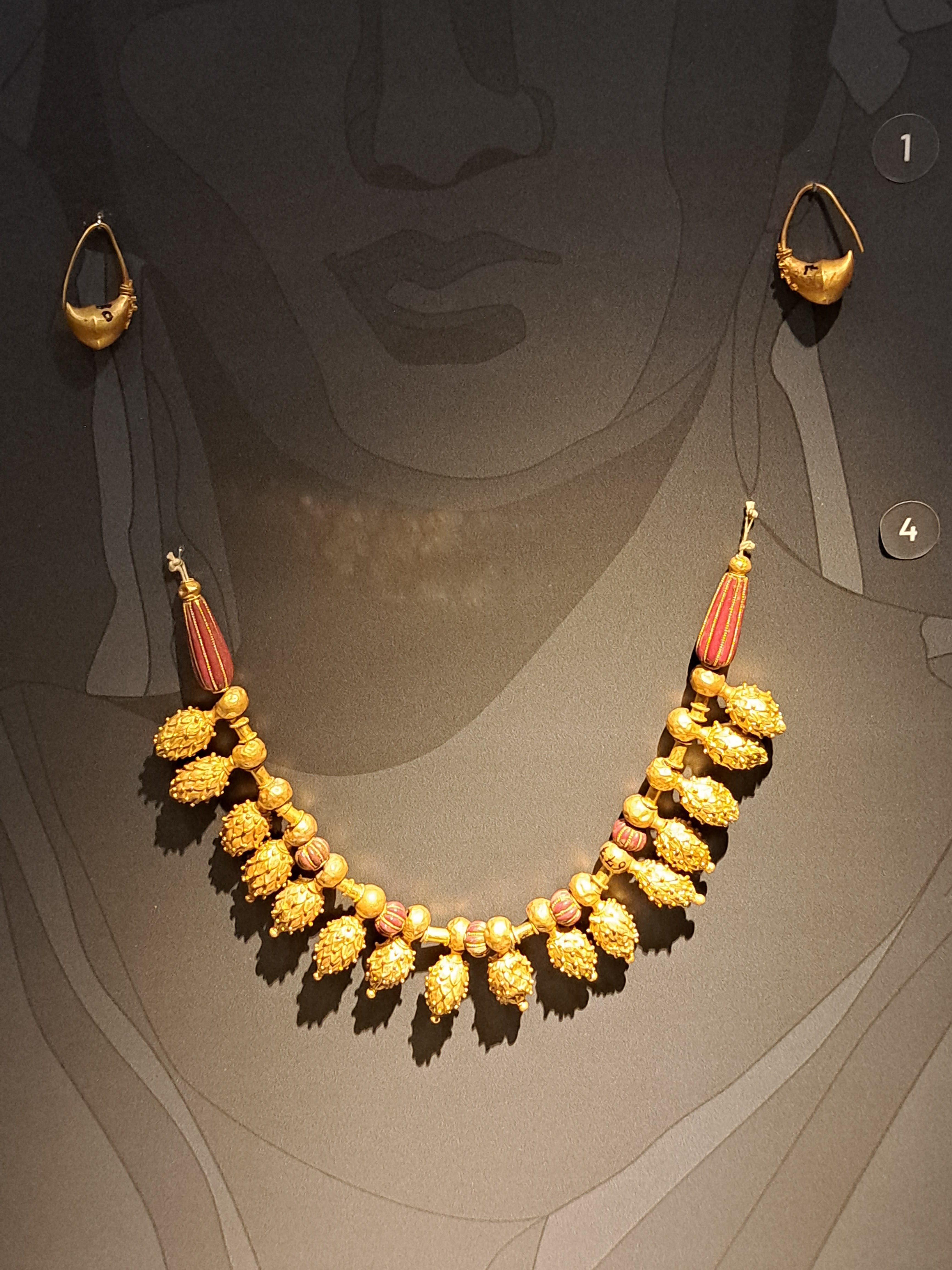
Gold Necklace and Earrings, 2,400 BC - Troy

     Archeologists have found that Troy is not just one city, but layer after layer has been uncovered. Over the course of some 2,500 years there were nine separate civilizations established. As mentioned, the museum is fascinating, the actual site not so much. There is little left of it and it resembles an abandoned rock pile. This seemed odd to both Cynthia and I given the treasures that were unearthed there. 

Crates of Pot Shards, Troy Archeological Site

     I had never heard of the Battlefields of Gallipoli. In Turkey it is famous, as it was a moment (actually almost a year) of glory for the Ottoman Empire in a war they eventually lost. As mentioned, Canakkale sits at the beginning of the Dardanelles Strait. The Allied powers desperately wanted to capture Istanbul as it was the key to having a supply route between Russia and England and France, who made up the Allied Forces. Winston Churchill was the First Lord of the British Admiralty, and there are records that show as he approached the Dardanelles Strait he sent a message to London saying they would be in Istanbul in two weeks. Amazing that he survived that stupidity. They launched a large naval attack in March,1915 only to be surprised and rebuffed. Then in April they did a major landing, seemingly having total dominance in terms of numbers and fire power. Incredibly the Ottomans, mostly Muslim, held out and it turned into bloody trench warfare. In December, 1915 the allies retreated to their ships. This was after some 130,000 soldiers died. As with so much in war, what a fucking waste. 

Gallipoli Cemetery

     We started the day at the Canakkale Epic Promotion Center which was quite the trip. One takes a tour where hi-tech 3D simulation equipment takes you on a tour of the battles. The floor moves, the sound is staggering, and you come out with definite knowledge of how the battle unfolded. The presentation definitely comes from the perspective of the Ottomans, which is no surprise. 

     The cemeteries on Gallipoli are numerous and sobering. Still, as we drove around the beautiful peninsula with astounding views of the Aegean Sea, we were glad we came. 

Gallipoli Cemetery on the Shores of the Aegean Sea

     Side note time. We are using Google Translate a lot. The people involved in tourism often speak English, but outside of that, not so much. We use our phone, speak into it in English, and out it comes in Turkish. It has saved our ass a few times. —— Cats. They are everywhere, and I mean everywhere. Few of them have owners. It reminds us of Santa Cruz, except instead of dogs, it is cats. For the most part they leave people alone and they don’t bark. Cynthia is definitely getting her cat fix!!!! 

Cat and Statue, Ephesus

     We were driving out of Istanbul and I saw a police car with a policeman standing there staring at us, complete with flashing light. Kind of scared me, and definitely got my attention. Wrong. It was a plywood replica of a police car complete with flashing light. What a hoot! We have seen many of them and it brings a smile every time. Not, however, the first time. —— The breakfasts at the three hotels we have stayed in so far are amazing. Great variety leads the way. Fruit, olives, bread, cheese, and omelettes if one wants them. The coffee scene can be lacking, but we brought Starbucks instant which actually is pretty damn good. Perhaps not up to the standards of our own Paxanax Primo, but good nonetheless. 

     Cynthia made the comment, “Being a tourist is hard work, but somebody has to do it.” That is not entirely a smart ass comment. We have been walking at least 10,000 steps a day, peaking out at some 18,000 one day in Istanbul. It can truly be exhausting. Tons of stairs, uneven surfaces, and path surprises galore can make it challenging. Add to that trying to figure out where you are, and where you are going. I am glad to report that Cynthia and I are still up to the task and having a blast doing it. As always, thanks for reading and another blog will come along soon.

Inscription on Grave Stone, Gallipoli

Friday, September 16, 2022

Vibrant Istanbul


Suleymaniye Mosque
Istanbul

     As always, the time warp becomes real when heading East making the big leap across the Atlantic.  One basically loses a day.  As we approached Frankfurt, Germany, we saw the sun peak over the horizon announcing the new day.  Ah yes, the Frankfurt airport.  God forbid one isn’t nimble afoot as stairs await at every turn.  From the minute one exits the plane, until you take the stairs down to get on the packed bus that takes you to the tarmac.  It sounds as though I am complaining, and maybe I am.  

     We arrived at the gigantic Istanbul Airport at two in the afternoon.  They did stamp our passport, but entry was seamless.  We had sprung for a private shuttle from the airport to our hotel in the historical Sultanahmet area of Istanbul.  Smooth sailing until we got into the narrow streets of the old city that were never meant for cars.  We ended up bailing from the car and walking the last couple of blocks.  Our hotel is well appointed and the location is good.  The room is small, which is OK, other than Cynthia and I struggle to find a surface for our stuff, and we are traveling light.  The neighborhood is a bit of a hoot.  Or maybe I should say boot.  We are in the middle of the shoe district.  Literally hundreds of shoe stores.  Everything for the foot one could imagine.  Kind of catchy at first, but the shoes come in boxes and, once emptied, the boxes fill the sidewalks.  One does a criss-cross pattern to get down the street.  Frankly, it kind of ruins the wha of the neighborhood, as Istanbul is a very clean city.     

Shoes, shoes, shoes!
Istanbul

Our good friend from Guatemala, Pat Torpie, arrived in Istanbul the same day we did.  We are doing things together while in in the city, then will go our own way the rest of the trip.  The three of us hired a guide for the first afternoon in order to get familiar with the city’s geography.  Well, make that the Sultanahmet area.  The city is huge, and it would take weeks, if not months, to explore the variety it has to offer.  Our guide was extremely knowledgeable and he took us to several of the most famous places that Istanbul has to offer, but also locations we never would have found on our own.   To begin with we went to the sites the city is most famous for.  That would be the Blue Mosque, the Aya Sofya and the Grand Bazaar.  From the outside one can imagine the majesty of the Blue Mosque, but on the inside it is quite disappointing.  Not the Mosque’s fault.  It is undergoing restoration and the scaffolding and other construction paraphernalia make it impossible to really get a feeling for the interior.  Despite this, it is still packed with tourists.  Construction was supposed to be completed in three years, but they are now well into year four, and it is reported another year is needed.  Good for the Blue Mosque, too bad for those who want to experience it. 


The Blue Mosque
Istanbul

     The Aya Sofya had large crowds as well, but one could still embrace the grandeur of what is now a mosque.   Our first day guide told us no one takes anything historical serious unless it is at least a thousand years old.  Well, the Aya Sofya was completed in 537 AD, on the backs of 10,000 workers, so it definitely passes the test.  The Aya Sofya has a complicated past as it was first built as a Greek Orthodox Church, then with a regime change a mosque, then a museum, then in a controversial decision was converted back into a mosque in 2020.  As will be the pattern in these blogs, rather than try and describe what we are witnessing, I will let Cynthia’s photographs give a much more compelling and realistic vision into what we are seeing.


Aya Sofya (Hagia Sofia) - Interior
Istanbul

     A little aside.  We noticed several large well fed dogs on the main mall near The Blue Mosque.  They all had tags in their ears.  Trivia, but a curiosity nonetheless.  We asked around and found out that they are ownerless dogs, but the city has neutered them and given them their shots, and then tagged them so everyone knows.  They look very healthy as apparently the city feeds them as well.  From what we witnessed they do a lot of hanging.  Now there is a dog's life!  Again, in the animal department there are cats everywhere.  Cynthia, being a serious cat lover, is thrilled.


Tagged and Good to Go!


     Make no mistake, Istanbul is a thriving city.  Added to the 15,000,000 residents, it is a tourist Mecca.  The old city, Sultanahmet, is packed with tourists, but we have found that if one leaves that immediate area there is still an abundance of people, but they are definitely locals.  The women’s styles are all over the place.  From black head-to-toe burkas, to stylish clothing one would see in Europe.  Though the country is definitely Muslim, there seems to be a definite freedom of expression.  The people watching is fascinating as variety is in abundance.

Women's Bazaar
Istanbul


     The days are so full.  Yesterday we began the day visiting the Basilica Cistern.  Incredibly, it was built in 532 AD.  Originally it was the water source for the Grand Palace, but was abandoned and not rediscovered until 1535.  It’s a huge underground cavern originally capable of holding 21,000,000 gallons of water.   There are 336 columns that provide it structure and one walks around the entire place on an elevated platform with the water right below.  There is a bit of light show going on to add to the bizarre atmosphere.  We both loved it. 


Basilica Cistern
Istanbul

    Then it was off to the Bosphorus Strait.  Now this large body of water, which seems like a river, literally divides Europe from Asia.  The locals, in fact, refer to the Eastern part of the city as the Asian side.  It connects the Black Sea to the Sea of Marmara.  Just for those geography buffs, the Sea of Marmara connects to the Aegean Sea, which in turn connects to the Mediterranean.  Though perhaps not the highlight of the trip so far, it was still good to get out on the water, with the sea breeze blowing, and see the palaces and mansions that line the shore.  If one were rolling in dough, regardless of what century, this was obviously the place to be.  We did learn a lesson with this journey.  We were on the Hop on Hop Off ferry where one can get off, look around, and catch the next one as it comes along.  Well, we came to what we thought was our final stop, many were getting off, and we just followed.  I looked around and commented that nothing looked familiar.  Cynthia immediately said, “Oh  my God, we got caught in herd mentality.”  Wrong stop.  We had to cool our heals, in an area we knew nothing about, for an hour until the next boat came along.  Not a big deal, but we travel independently so as not to get caught in the follow-the-leader mentality. 


Dolmabahce Palace - 1843
Istanbul

     Not that you are concerned, but just to let you know Cynthia and I are eating well.  The few restaurants we have been to have incredible variety.  Every kind of kebob one can imagine.  Last night I had a sword fish kebob that was delicious.  Cynthia has become a fan of Adana kabap (Turkish name for kebob) which is a mixture of lamb and beef, with a touch of spice.  One can also satisfy their desire for pizza, though here it is called pide, and the crust is pita bread.  Actually different from the pizza we know both in look and taste.  And then we have become very familiar with Efus, the local go-to beer.  Frankly not a great beer, but it hits the spot nonetheless.


Sweets anyone?

     As most of you know I politically lean very far to the left.  The reason I mention this is that today we visited the Topkapi Palace.  It was the headquarters of the Ottoman Empire between the 15th and 19th centuries.  Lonely Planet describes it as the domain of “Libidinous sultans, ambitious courtiers, beautiful concubines and scheming eunuchs.”  If the majority could live like this, maybe, but the sultans lived in luxury unheard of by the masses.  Now I realize that is still the case, but somehow this seemed even more egregious.  Who the hell needs three hundred concubines?  Sounds exhausting.  The upside is that now these domains of the rulers are open for public inspection and they are, indeed, spectacular.  If hadn’t been for a super wealthy royal elite, we would never have these incredible works of art, which many of the palace rooms indeed are.  A couple of asides in regard to the Topkapi Palace.  The eunuchs were powerful within the palace in that they were the protectors, and also the money watchers.  They were almost exclusively black.  Most of the concubines were captured slaves who were then trained to be concubines.  Skills to be learned included Turkish culture and language, music, the art of make-up, music and writing.  It apparently took a lot to please the Sultan!  In fighting among the concubines was apparently not rare and there were even tales of murder.  


Iznik Tile, Harem, Topaki Palace
Istanbul


     Our final Istanbul destination, until our return at the end of the trip, was the Grand Bazaar.  Established in 1461, apparently by a sultan that loved shopping, it is truly the heart of Old Istanbul.  The entire Bazaar is covered, which given its size, is an accomplishment in itself.  There are lanes winding everywhere, big and small.  And today they were are all packed.  I can’t overemphasize how large this market place is.  Getting lost, as we definitely did, is just part of the experience.  At the end Cynthia and I were just going, "How the Hell does one get out of here!!   Even if one doesn’t want to shop, and we didn’t, there are teases everywhere.  I expected the shop owners to leap into our paths trying to entice us with their wares, but thankfully this was rare.  We did find shops that intrigued us, but we escaped with a pair of earrings for Cynthia and a thumb ring for me.  I want to emphasize that this is not predominantly a tourist thing.  Most of the hordes of people were Turkish.  They clearly love their Grand Bazaar.


The Grand Bazaar
Istanbul

     The tourist industry in Turkey seems to be alive and well, supplying some 11% of the GNP prior to the pandemic.  This has been apparent in almost all of the places we have visited.  The good news is that the city is vast, and therefore it is possible to find places that are away from the madding crowd.  Speaking of the pandemic, for those of us still concerned with getting covid, Istanbul would be a tough place to be.  Masks are not seen, crowds are everywhere, and I personally don’t know how prevalent covid is here.  Cynthia and I are hoping for the best.  The day before we left I got an omicron booster, and Cynthia is boosted as well.  I guess it is time to live life and trust in the covid Gods.  Whatever that means!                       


     Luckily the weather has been perfect, so the heat has not been oppressive.  If extreme heat had been added to the mix it would have been rough.  At the end of each day we are exhausted, though upbeat.  Tomorrow morning we pick up a rental car and leave the metropolis of Istanbul.  A fascinating city for sure, one that has more to offer than can be digested in the 4-1/2 days we have been here.  As always, thanks for reading and we will be back soon!!


Hookah Pipes


Tuesday, October 16, 2018

Roaming Romania

St. Nicholas Russian Orthodox Church
Bucharest, Romania

     We arrived in Romania not really knowing what to expect.  We knew little about Bucharest or the country maybe because it was towards the end of the trip and we hadn’t done our research.  We did know that there was an “express” bus from the airport to the city center and we elected to give it a try.  Not that it’s all about money but $2 vs an estimated $30 via taxi, not to mention the adventure.   One does go through some anxiety because it is not as though the bus driver is calling out each stop.  And despite the express tag there were plenty of stops.  We figured it out, exited the bus and immediately it was “what’s next?”  We took an educated guess, showed the address to a woman who spoke no English and through her hand signals we found our Airbnb.  One of our favorite of the trip actually.  Right in the Old Town, spacious, lacking nothing.  Well one does have to wind their way up to the third floor via a spiral stair case but, hey, what’s perfect.  


Pedestrian Street
Old Town Bucharest, Romania

     One may get a false impression of a city if all one sees is the Old Town, but from our experience it seems to be the most interesting part.  Certainly the most easy to navigate, mostly pedestrian streets so very little traffic, fascinating OLD buildings and plenty of places to eat and get a late afternoon beer.  Bucharest is no exception to this.  We had a day and half to wander the streets and take in the sites.  Unfortunately both times we were there it was a Monday and Tuesday and several of the museums and other highlights were closed.  But the visuals, as Cynthia’s photos show, were stunning.  


CEC Palace
Bucharest, Romania

     We concentrated on three cities in Romania, the capitol of Bucharest and two cities in Transylvania, Brasov and Sighisoara.  We opted not to rent a car so the train was our main means of transport between destinations.  Clean, comfortable and not too expensive.  Romania is a very likable country.  It has the mystery that the name Transylvania evokes, very old and fascinating architecture, and a history that is definitely complicated by their location.  As with many of the Balkan countries they are caught between the East and the West.  The Romans wanted this territory and so did the Turks.  The marauding hordes from further East came as well.  The Nazis occupied Romania during the Second World War and they were “liberated” by the Russians.  “Meet the New Boss, Same as the Old Boss”. 


Brasov Main Square from on High
Brasov, Romania
  
     As our train pulled into the Brasov train station we were a bit worried.  The city seemed a lot larger than we expected and the outlying areas did not look too appealing.  There are quite a few holdovers from the Communist era and large block type buildings are in abundance.  As our cab got closer to the city center we began to relax as the scene much improved.   We passed a beautiful open square which we would eventually get to know well.  Our Airbnb was a 15 minute walk to the center and though not our favorite was certainly adequate.  The first afternoon we walked the old town area and got familiar with the town’s layout.  We entered the walled city via the same entrance that had been used since the 14th century.  We walked the narrowest street in Brasov - String Street - where every window decoration was painted by local young artists.  


String Street
Old Town Brasov, Romania


Romanian Orthodox Church
Brasov, Romania

     They asked please no graffiti but gave a specified location where one could do as they please.  We left our John Hancock's for posterity.  This trip seemed to feature gondola rides and Brasov had theirs.  Not as dramatic as we had experienced in Slovenia but still definitely worth the admission.  It took us high over the city and right next to the Hollywood style sign announcing that you were in Brasov.  We walked the mountain trails and got a needed shot of nature.  


Street
Old Towns Brasov, Romania

     Transylvania has a ring to it and we all know why.  The home of Dracula.  Actually it is the home of Vlad Dracul (Vlad-the Impaler - 1428-1476) who supposedly inspired Bram Stoker’s 1897 novel “Dracula”.  One can’t really go to Romania, or certainly Brasov, without visiting Bran Castle the debatable “home” of the Dracul family.  
     
Bran Castle
Bran, Romania
     We had liked the taxi driver who gave us the initial ride to our Airbnb so we hired him to take us on a day trip to the castle and another historic site, Rasnov Fortress.  The thing that appealed to me about Bran Castle was that it hadn’t been all spiffed up for the tourists.  The floors creaked, it was definitely not handicap friendly, and one could easily let their imagination wander to times past.  From the outside the castle was dramatic, yet unassuming.  We spent a couple of hours exploring on our own, then moved on to Rasnov Fortress.  
     
Rasnov Fortress
Romania

     Here we had no idea what to expect but were pleasantly surprised.  Built early in the 13th century it was a walled fortress created to keep the invading Turks at bay.  Nothing fancy but real.  There were few other visitors, no created structures just for the tourists, some great views of the surrounding valleys, and an authenticity that stuck with you.  Definitely worth the time.
     From Brasov we moved on, again by train, to Sighisoara.  For some time we called it the S town because we couldn’t pronounce the name.  I must say that by the time we left we were pretty good at it. Sig-hee-sho-a-ra.  Sighisoara turned out to be one of our favorite destinations.  


Clock Tower
Old Town Sighisoara, Romania

     Small with some outstanding architecture.  Medieval towers abound, a clock tower like no other we had seen, stone streets that make Antigua streets seem like smooth pavement.  Those of you who follow our blogs know that we have a habit of running into festivals of one sort or another that we had no idea were happening.  It happened again in Sighisoara.  Though billed as a celebration of Saxon culture it pretty much covered the spectrum.  There was a young girl doing yodeling which I absolutely loved.  She would be an excellent contestant for Romania has Talent!  Cynthia posted a video of her on Facebook.  Check it out!  https://www.facebook.com/davis.cynthia/videos/10156740795734596/    To contrast with this was a church organ recital, a rocker who billed himself as “Home of the Dragon,” as well as folk dancers and bands. It was quite the show.  From the base beat, even though we were removed from the main square, we heard remnants of the festival until 3 a.m.!!  Sighisoara knows how to party!  


Festival Band
Sighisoara, Romania

     Today is our last day in Romania and for this adventure.  Tomorrow morning at a seriously obnoxious hour we are off to the States.  I do have some reflections.  I mentioned cost before.  Romania is definitely less expensive than some of our other destinations.  We could eat well for $20-$25 unless we overdid it on the booze which we seldom did.  If one is looking for a totally economic trip, Eastern Europe is not necessarily it.  Culturally it is interesting but one does not notice the drastic differences among the population one sees in some cultures (India, SE Asia, Guatemala).  People of color are no where to be seen.  The Romanian Gypsies certainly stand out but unfortunately we saw few of them.  Most of the music one hears would fit in well on an American classic rock station.  The infrastructure is advanced for the most part.  The water is drinkable.  One can flush their toilet paper.  Everyone is on their cell phone.  One can eat pretty much anything without thinking about getting sick.  What makes it appealing to me is its history and age.  Trying to figure out the political intrigue form ancient times to the present is complicated at best. Much of its physical nature has been preserved resulting in areas that defy time.


Turret
Old Town Sighisoara, Romania

     We experienced many languages yet found enough people who spoke English to make the traveling not too challenging.  Currencies galore.  Of the 7 countries we visited only two were on the Euro, the rest one had to do the math, and not get stuck with it when you left.  Mass transit was good in every large city we visited.  Unless one is on a group tour (no fun at this point for Cynthia and me), better get to know it.  And finally Eastern Europe is not an unknown destination for travelers.  I think coming in September/October was perfect yet their were still tons of other travelers, especially in Budapest and Dubrovnik.  If there is a reason to have one's own transportation it is to be able to get away and explore unchartered areas.  
     No question Cynthia and I had a great adventure.  All new countries, getting to figure out where we were going and how to get there, meeting some wonderful locals, getting out of our comfort zone (though less than previous trips), and just enjoying life on the road.  Thank you so much for sharing it with us through this blog.  Work it is but pleasure it brings.           

Back Street
Old Town Sighisoara, Romania
All photographs copyright by Cynthia Davis, 2018.  All rights reserved.        

Friday, October 12, 2018

Meandering Through Montenegro

Bay of Kotor
Montenegro

     Oh my God, a border!  As we left Croatia in our rental car we actually came to a border crossing where one had to hand over their passport.  And the line of cars was not short.  An hour later we entered Montenegro for the first time.  Our destination was Kotor, which is at the very end of the Bay of Kotor, a crooked pencil shaped inlet that goes on for miles.  As we drove along the road got narrower with the beautiful inlet on our right and dramatic mountains on our left.  We decided against the ferry and continued through several smaller towns whose focus clearly was on tourism.  As we arrived in Kotor our usual search began for our Airbnb.  The road was so narrow at this point a wrong move would put one in the water.  When we finally found it we were pleased as the view from the front terrace was fabulous and it had all the basic requirements.  
     Kotor is known for its Old City.  Though not new to us at this point we still enjoy the atmosphere, architecture, age, and scene that accompanies the narrow byways.  On our first morning, instead of jumping right into the Old City, we decided to take advantage of our car and drive to the Lovcen National Park.  The park itself didn’t get outstanding reviews but the road trip between Kotor and the Park did.  Our friends Richard and Sylvia had highly recommended Montenegro (which they traversed by motorcycle) and now we could see why.  The road was incredible including the long-haired goats determined to block our way.


Sharing the Highway
Montenegran Long-haired Goats
Road from Kotor to Njegos Mausoleum, Montenegro

     As one went up, up, up traversing the many switchbacks and the one lane road the views just got more astounding.  Looking over the steep drop off, first came the beautiful Bay of Kotor with the backdrop the shear rock mountain side.  When one gets high enough the distant view turns into the endless Adriatic Sea.  Quite the thrill.  I, of course, wanted to pull over at every semi-possible opportunity but Cynthia, being a bit more sane, insisted on waiting for the safest spot.  Plentiful they were not.  


Road from Kotor to Njegos Mausoleum
as indicated on the GPS

     By the time we reached the Njegos Mausoleum, which is the culmination of the Park road, the temperature had dropped and we were partially enshrouded in clouds.  We decided it was time for a break and luckily found a place to park the car.  Not that there were that many people there but again it was a one lane road with nowhere to go and certainly no “assigned parking”.  We looked around, had a great bowl of soup, and marveled at the deciduous trees showing off their fall colors. 
     We took a different route back to Kotor and passed through Cetinje, the former royal capital of Montenegro.  We took a leisurely stroll through the main walkway of the town and the fact that Montenegro is a poor country began to be apparent.  Museums closed, buildings that had once seen glory days were sadly neglected, and it clearly didn’t have that revitalizing shot of tourist dollars to spruce it up.  We enjoyed our peruse of the town but found little reason to return.  Nor did Cynthia find anything worth photographing.
  We are finding this Eastern European trip is not inexpensive.  The Airbnb’s are a great value so we don’t feel we are getting gouged on that front ($45-$75 a night out the door) as a decent hotel is over $100 per the Trip Advisor research I have done (yes, hostels (hostiles) are less).  


One of Our Airbnb's
Prague, Czech Republic

     But the restaurants.  Cynthia and I have been spoiled by India and South East Asia where two people can easily eat out for $10.  And eat well.  Not so in Eastern Europe.  $20 to $50 is standard, usually closer to the higher end of the scale (can’t kick the wine or beer with dinner habit).  Now I realize that in the States this is not a huge amount but when one is doing it every day it certainly adds up.  We are eating one meal out as we always have breakfast “at home” and usually don’t do lunch.  This is a preamble to a situation that I couldn’t imagine happening in many places.  We were short on Euro when we went to the “Relax Restaurant and Bar”.  It was very low key and we were ready to save a bit of money on our meal.  When it came time to pay I handed our waitress a credit card.  “Sorry, cash only.”  We didn’t have it.  I offered the 10 Euro we had and my drivers license and said we would return with the rest.  She just smiled, said don’t worry about it, pay tomorrow.  She didn’t even want the !0 Euro or the drivers license!  The trust did our hearts good.   
     If one goes to Montenegro watch out for the speed traps.  They were plentiful.  And the speed limit is rarely over 60 kph (38 mph).  We were heading to the Ostrog Monastery and suddenly there is a policeman standing in the middle of the road waving a stop sign.  Rats!!  72 in a 60.  I did my polite best and saw not a smile from the cop.  In the end he took pity and off we went, at the agonizingly slow 38 mph!  Well, it all turned out to be worth it.  The drive was beautiful with the colors popping out of the rocks forming the mountain sides.  As mentioned our destination was the Ostrog Monastery, which turned out to be a totally unique place.  


Ostrog Monestary
Montenegro

     It is reminiscent in ways of the monasteries we visited in Spiti, India.  Built in seemingly impossible locations basically glued to the side of a sheer cliff.  As we ascended the mountain by car we saw people walking up the mountain trail carrying their belongings.  What on Earth?  We parked the car in the provided lot, saw that we still had a serious climb ahead of us, and stopped to ask the lot attendant about our the best route back to Kotor.  He spoke virtually no English but motioned that we could still go further up the road even though there was a barrier.  He managed to say the word “old” and we got it.  Seniors were allowed to drive up another 1/2 mile and park nearer the monastery.  So much for our youthful look!  
     Though the monastery itself was impressive it was the scene that got to Cynthia and me.  The faithful took this place seriously.  Families with their children, older people, a scattering of the young were all there.  It was a pilgrimage for many.  They would bring their blankets, food and whatever other essentials they needed and set up camp right on the concrete area in front of the monastery.  Blankets apparently were supplied to the needy free of charge.  Pretty much any place that was sleepable was taken.  


The Pilgrimage
Ostrog Monestary, Montenegro

     I did read that one could rent a dorm room but hundreds were just making it on their own.  No restaurants so bring what you want to eat.  No roof so be prepared for the rain and sun.  It was a captivating scene and Cynthia and I basically hung out and wondered.  The line to get into the monestary itself was long and we decided to take a pass.  To us what was fascinating was outside and the inside could remain a mystery.  
       
St. Luke's Orthodox Church
Old Town Kotor, Montenegro

     The morning we left Kotor for our return to Dubrovnik and our flight to Romania we cruised the Old City of Kotor.  Really enjoyable.  Not crowded, old fort walls that ascend an almost sheer cliff, the classic narrow lanes where the stone paths are made of stones that are as smooth as a baby’s butt.  Hundreds of years of footsteps have done that.  And, oh yes, the cats.  Strange to focus in on that but it was unavoidable.  Cats galore and Cynthia loves them.  We came upon one bench that held no fewer than eight cats all entwined.  


A Passel of Cats
Old Town Kotor, Montenegro


     We saw collection buckets that asked for help in feeding the cats and our conclusion was they needed a bucket to get some cat neutering done!  Still fun to see them all, especially the predominant calicos.     
  We exited our one-night-stand room near the Dubrovnik airport at 4:30 a.m. to make our early flight from Dubrovnik to Bucharest, Romania, our last destination on the trip.  More from the land of Vlad Dracul in our next and final blog.  As always thanks for reading!

Staircase
Old Town Kotor, Montenegro
All photographs copyright by Cynthia Davis, 2018.  All rights reserved.